The Most Important Clock Is In Your Brain Not On The Wall
Circadian biology is the study of the 24-hour cycle that controls nearly every physiological process inside of us. From how balanced our hormones are to how deeply we sleep, our bodies are finely tuned to an internal clock inside our brain.
💡 The First Principle: We are nature. Our environment and timing determine whether our body runs like a "well-oiled machine" or if it needs to be recalibrated.
1. The Master Clock vs. Peripheral Clocks
For billions of years, life evolved under a strict cycle of day and night—uninterrupted by today's chaotic artificial light and mismanaged eating times. To survive, life developed an internal timer to send the proper signals at the proper time to the organs in order to keep the body in sync and working optimally.
Your body actively senses the environment, primarily light and prepares for either daytime or nighttime work using a network of clocks:
The Master Clock (SCN): Located in the hypothalamus of the brain, the Suprachiasmatic Nucleus is a tiny cluster of neurons. It acts as the "boss," sensing environmental cues and sending signals out to the rest of the body.
The Peripheral Clocks: Your body has trillions of individual clocks located in the cells of every single organ (like your liver). The Master Clock sends hormonal and neural signals down to these organs to ensure they do their daily jobs at the optimal times.
🔄 The System in Action
🌅 While You Wake Up: As dawn approaches, your body senses it is morning. Your core temperature rises, your adrenal glands begin to produce cortisol (the alertness hormone), and your brain shuts down melatonin (the sleep hormone).
🌌 Before You Go to Sleep: Once your eyes and skin sense darkness, your body winds down digestion. It begins pumping out melatonin from the pineal gland to lower your core temperature and induce deep sleepiness.
2. Zeitgebers: The "Time-Givers"
To keep your body precisely aligned with the real world, your internal clock must be reset daily by environmental cues called Zeitgebers (German for "time-givers").
The two most powerful inputs your Master Clock relies on are:
☀️ Light (The Primary Cue): In the early morning, bright light (specifically the blue wavelengths found in sunlight) hits specialized cells in your eyes. This directly signals the SCN that it is daytime—turning down melatonin, increasing cortisol, and kickstarting growth and digestion. (Note: There is healthy light and junk light, which requires its own breakdown).
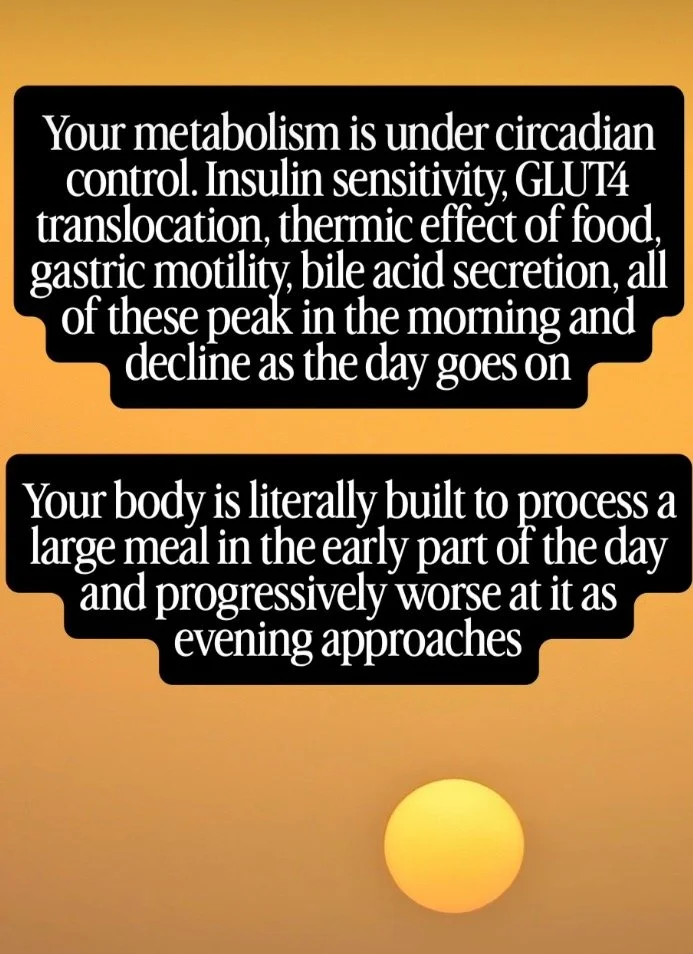
🥑 Food (The Secondary Cue): When you eat, metabolic signals reset the peripheral clocks in your digestive organs and liver. Eating breakfast signals your digestive system to start releasing enzymes, secreting insulin, and preparing for a bowel movement to get you going for the day.

🚨 Circadian Mismatch: The Cost of Modern Convenience
Circadian mismatch occurs when our modern lifestyle sends conflicting data to our master and peripheral clocks. This internal chaos—where different organs are getting the cue at the wrong time—over time directly triggers inflammation, sleep disorders, metabolic decline, weight gain, hormonal imbalance, and chronic fatigue.
🛑 Daily Habits That Cause Mismatch:
📱 Junk Light: Looking at bright screens or turning on artificial LED lights after sunset or before sunrise.
☕ Caffeine in the Dark: Drinking caffeine before the sun rises forces your body to alert itself without natural environmental cues.
🥭 Out-of-Season Eating: Eating non-local, high-sugar foods (like a mango in a Canadian winter) disrupts your rhythm. Your body lacks the natural summer sun required to optimally process that sugar.
🧱 The Foundation: 5 Rules for Lifestyle Consistency
You must build the foundation before stacking supplements or superfoods. There are no shortcuts.
1. 🌅 Mornings: Think Natural Light
Get outside and view natural sunlight first thing in the morning.
If you wake up before dawn (especially during northern winters), use a red incandescent light until the sun rises.
⚠️ DO NOT drink caffeine in the dark.
2. 🌌 Evenings: Think Darkness
Avoid bright, artificial blue-lit screens.
After sunset, turn your screens red and wear blue-blocking glasses to allow your brain to begin secreting melatonin.
⚠️ DO NOT eat within 3 hours of bedtime.
3. ⏰ Optimize Your Sleep Window
Go to bed at the same time every night, ideally before 10:00 PM to unlock the deepest, most restorative sleep phases.
4. ⏳ Narrow Your Eating Window
Confine your meals strictly to daylight hours to keep peripheral metabolic clocks aligned with your brain and maintain optimal insulin and blood sugar levels
Front-load your carbohydrates: Eat the majority of your carbs early in the day when your insulin sensitivity is highest. Never eat after dark.
🌟 The #1 Step to Start Today: If you only change one thing, focus on blocking artificial blue light at night.
📊 Checklist: Is Your Circadian Rhythm in Sync?
Digestion💩 You have regular bowel movements daily around the same time.
Waking⏰ You wake up naturally without needing an alarm clock.
Energy⚡ You feel genuinely rested and wake up hungry after about 30-60 minutes.
Sleep💤 You have stable, predictable sleep patterns and get tired naturally before 10:00 PM.